Digital transformation today means that firms are tasked not only with becoming more efficient, but also enhancing the overall consumer experience. Doing so is a question of survival. By 2022 global spending on technologies and
service
s that enable digital transformation of business practices, products and companies is expected to reach us$1. 97trn, according to market research firm, international data corporation (idc).
 That’s a five-year compound annual growth rate of 16. 7% from 2017 to 2022. The drumbeat of digital transformation continues to grow louder across industries. As greater numbers of consumers become more digitally proficient, the scope of digital transformation for firms both big and small is widening, and becoming ever more vital.
Digital transformation is not a product or a solution. It’s a continuous process involving new technologies and ways of work ing to compete successfully through continued innovation. It must encompass technology, culture, and processes—in concert with one another.
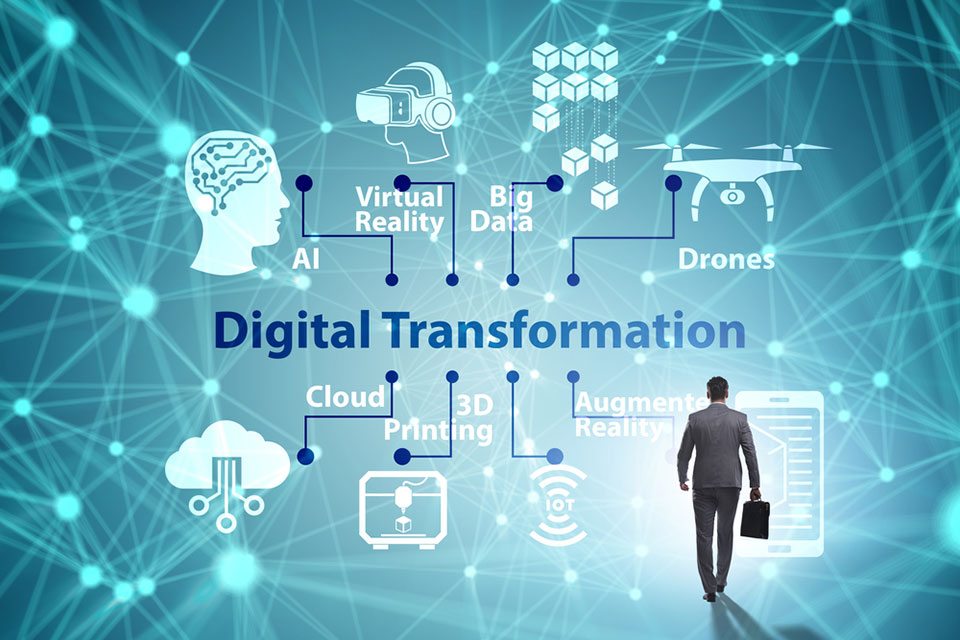
Today's digital transformations require more than supplying internet connection, email, and digitizing paper records in the office. The trend has grown beyond that. Technologies such as cloud services, mobile devices, and the power of the internet of things (iot) continue to alter the digital landscape in innovative ways. But the aim remains to leverage the latest technology to improve user experience and effectiveness. Cloud services — many companies are aware of cloud services, such as salesforce for crm, google for productivity, and amazon for infrastructure. But digital transformation is an ongoing process prompting companies to refresh their technology and keep pace with customer needs.
For established companies, the pressure to digitize business models and products has reached new intensity. Mckinsey research shows that the best-performing decile of digitized incumbents earns as much as 80 percent of the digital revenues generated in their industries. Ascending to that elite group is far from easy. In a new survey of more than 1,700 c-suite executives, we learned that the average digital transformation—an effort to enable existing business models by integrating advanced technologies—stands a 45 percent chance of delivering less profit than expected. The likelihood of surpassing profit expectations, on average, is just one in ten. 1 1.
How to develop a digital transformation strategy
While some of the obstacles to digital-transformation success are well known, our newest mckinsey global survey on digital strategy and investments asked business leaders about the evolution of these challenges, digital tech’s role in their businesses, and companies’ strategic responses.
 2 2. The online survey was in the field from january 25 to february 4, 2022, and garnered responses from 1,331 c-level executives, senior managers, and business unit, department, or division heads representing the full range of regions, industries, company sizes, and functional specialties. Nine in ten c-level and senior leaders say their organizations have pursued at least one large-scale digital transformation in the past two years.
“disruption,” “digital” and “transformation” are etched into business vocabularies—a sign of the pressure business leaders face to deliver differentiated solutions at market speed while meeting customer expectations and retaining their trust. You know that in order to compete and thrive, your company must have the ability to continuously respond and adapt to your customers’ ever-changing needs. Sometimes, that means undergoing transformational change. But how do you do that efficiently while maintaining control over your operations and sustaining the level of service your customers demand? kpmg brings an industry-leading approach to enterprise-wide transformation that aligns your technology strategy with your business strategy.
Digitalization is always progressing. As it does so, it brings with it profound changes, impacting individuals, families, enterprises, and industries — even entire cities and countries. With the introduction of digital technologies into all aspects of human society — from artificial intelligence (ai) and the cloud, to the internet of things (iot) and 5g — digitalization is actively supporting the construction of smart cities, driving the digital transformation of industries, comprehensively improving the consumer experience, creating new unimagined products and services, and promoting social progress and development. It's personal digitalization establishes high-quality connections, anytime, anywhere for individuals, digitalization ensures the availability of connections,.
Newsletter signup interdependence and interconnectedness are essential aspects of digital transformation. Transitioning a traditional enterprise into a modern software company requires adopting a startup state of mind. It means not taking infrastructure for granted, but rather moving to modern infrastructure that promotes and enhances an organization's core expertise and values. Digital transformation also has to include wide-reaching organizational change to foster true disruption, including the adoption of agile and lean methodologies as replacements for traditional approaches to how software and services are built and delivered. Although it’s impossible to predict if and when any business will succeed, those undertaking digital transformation have the best chance of success because they are building in competitive advantage by rethinking existing processes and transitioning to new, agile development methods using modern infrastructure.
What are the benefits of digital transformation?
We empower businesses to live the benefits of digital transformation. When digital creates the conditions for continuous innovation, the only limit is your ambition. Where will you take it?.
For a majority of u. S. Ceos, the pandemic has meant an acceleration in digital transformation by months or even years. “the move to digitization has accelerated, and the benefits will be permanent,” says kpmg’s carande. “there is no going back. ”. Impact of the pandemic on digital transformation across the following areas of enterprise digital transformation, please say what impact the pandemic has had on progress. While better serving customers has been a top driver of digital transformation in the past, it often meant that companies had to be careful about how quickly they introduced new technology solutions and how advanced these solutions were.
What are digital transformation challenges?
The economic theory underpinning the disruptive effects of digital technology introducing digital transformation. Exponential evolution of technology. Economic concepts of the digital economy. The economics of innovation. Deconstruction of the value chain. Cases: (1) how instagram has evolved using open source; (2) observability at google. Cross-cutting technologies and their impact on industries and companies data science for managers. What is big data; three vs. Data-driven decision-making. Fundamental elements of ai. Key challenges with ai. Applications of ai in management. Introduction to platforms. Platform economic concepts. Blockchain. Decentralization: the core and the crowd. Limits to decentralization. Cases: (1) how spotify uses machine learning to personalize the user experience; (2) hyperledger and blockchain at ibm.
Cynthia ramsaran on august 10, 2022 at 12:02 pm | reading time: 1 minute effective digital transformation can accelerate organic marketing growth—and maintain that growth despite future economic or regulatory challenges. Join search experts from conductor in an upcoming webinar and learn: the crucial role organic and seo play in enterprise digital transformation. The importance of diversifying marketing efforts and what that looks like. How to apply data-driven insights to elevate the customer experience.
The centre for digital transformation helps businesses understand the far-reaching organisational implications of the digital revolution. From artificial intelligence (ai) to the internet of things to blockchain, the centre’s work focuses on new and emerging digital technologies, and how they can be leveraged to meet both business and social objectives. Collaborating with leading academics across imperial college business school and the wider institution, the centre engages in cross-disciplinary research on the impact that digitalisation will have on the future of work to help businesses understand how to innovate to address the challenges digital transformation presents.
Dig Deeper on Digital transformation
In the last two years, businesses of every size have confronted the impact of covid-19, including supply chain shortages, inflation, the rise of hybrid work and the great resignation. If there’s any lesson to be gained from these experiences, it’s that flexibility and agility are vital. To ensure their resilience, organizations are spending big on digital transformation. Gartner projects that worldwide it spending will total $4. 4 trillion in 2022, increasing 4% over 2021. Gartner also says this aggressive spending isn’t a temporary blip—it’s a long-term trend. It also points to projected double-digit growth in spending on enterprise applications and infrastructure software in 2023.
Digital transformation better connects people, processes, and manufacturing ecosystems to help you achieve more machine uptime and boost output and productivity while reducing waste and re-work.
Even before the pandemic, two words seemed to dominate the vocabulary of every executive in corporate america: digital transformation. It was inescapable. Suddenly, nearly three decades after the advent of the internet and over a decade since the first iphone was released, companies seemed to finally realize the power of technology. And with artificial intelligence, two equally buzzy words that are now impossible to avoid , companies could finally make use of mountains of consumer data to ensure they would never miss a sale, fumble a customer service call or encounter a blip in the supply chain. That, by and large, hasn’t happened: air travel is abysmal, health care is still stuck with one foot in the past , store shelves are still stocked with an overabundance of items no longer in demand, supply chains are a mess , algorithms are still bad at suggesting things we might like , and customer service largely remains an infuriating experience.
With recent events amplifying the rate of transformation, the digital divide between organizations has never been more obvious. Those with responsive business models, and flexible technology platforms are able to pivot to address changing customer demand patterns and new ways of working. Those without the digital capabilities needed to navigate the crisis, are fighting for survival. Now is the time to reflect on what you are doing as a company, take stock, adapt and create resilience in response to the next normal.
Comments
Post a Comment